The Secrets to Successful Leaps
One of the biggest struggles singers have when attempting to sing a beautiful phrase is how to approach a leap. I define a leap as a skip larger than a fourth (example: C to F). The key here is breath support. You can tell when the breath support isn't stable if you're singing a leap and you need to add an "h" sound to your vowel. Also, the tone becomes breathy. The air needs to spin faster as you ascend in pitch and you know that you need to support the tone with great breath support. But are there any tricks? Yes!
First off, you need to recognize the highest pitch in the phrase. Rarely will the highest note of the phrase be the very first pitch, so you need to prepare your inhalation for the highest note. This means you must create the space in the back of the mouth, and also between your jaws, that is required for the highest pitch. Then, inhale and prepare the body as if you're singing the highest note first. It's ok to have a little more space and breath support than you need for the lower notes, but never is it ok to have not enough space and support for the top notes.
Secondly, you'll want to put the consonant that begins the word of the highest note onto the end of the word from the preceding lower note. Rather than having to stop the air flow to put on the consonant, this will allow you to ascend entirely on the vowel. Remember, a crisp explosive consonant will act as a springboard to propel the sound up and out.
The last great trick is to begin singing louder on the bottom note and continue the crescendo through the top pitch. Think of riding a bike uphill. It's much easier if you start pedaling faster on a flat surface before you reach the hill rather than attempting to begin with a dead stop at the bottom of the hill.
Obviously your body alignment and breath support is key, but hopefully with these tricks, you'll find a much more successful way to sing your leaps.
Why Students Don't Practice
It doesn't take a rocket scientist to figure out that not all students taking music lessons practice as they should. Just like when a student doesn't turn in his/her homework at school, a teacher can tell if a student has been practicing or not. As a private music teacher, I often wonder why a student would choose to pay for private lessons if they aren't going to practice what they're learning. Here's what I've come up with.
First, some students just plain don't want to practice. Which should lead them (or their parents) to question why they want to take lessons in the first place. If you only want to sing for 30 mins a week (if you even enjoy your actual lesson time), then private lessons aren't for you. It would be like hiring a personal trainer that you see once a week, and never work-out in between sessions. You simply won't make progress.
Second, they lack the time management to allow for adequate practice time. Ideally, students would have 30-60 mins each day to practice, but even as little as 30 mins 3 days a week can help your progression. When deciding if you, or your child, should take private lessons, look at your schedule. It is essential that you make time, several times a week, to practice.
Many students don't realize that the best progress is made during their practice sessions between lessons. The teachers are there to show you the next step, and to give you guidance on how to execute that step properly. But, you won't actually master it in their studio. You will master the technique in your practice time.
Fourth, often students, especially singers, won't have the right equipment to practice with. I think it's really important for singers to have a piano to practice with, but that's not always possible. I record each student's lesson and send it to them each week so they may practice with it. If your teacher doesn't do this, ask if you can record your lesson to practice with at home. Also, you MUST have a metronome. Singers are notorious for not being able to count, and practicing with a metronome will absolutely help.
Lastly, the biggest reason students don't practice, is that they don't know how. They leave the lesson without a clear understanding of what is to be expected and how to practice. Please ask your teacher how and what you should be practicing. Your teacher is always there to help you and ABSOLUTELY wants you to practice!
Practicing is the most important part of taking private lessons. If anything, it's an opportunity to sing (or play your instrument) every day. And as parents, we can help support the students by giving encouragement when they do practice, offering help and guidance (even if you aren't quite sure what you're doing), and allowing the student to be creative and open-minded while learning their new skills.
Thirteen: A List to Sing By
I try to tailor each of my lessons to be as unique and individualized as the singers themselves. But, sometimes, there are a few things that I "preach" across the board. Here are the 13 things I say to each of my students.
Long Spines and Wide Bodies
I rarely tell a student to stand up straight. It's amazing what those words, combined with the word 'posture', do to a person's body. Instantly they get as straight as possible and put an enormous amount of tension in their shoulders, back and neck. Instead, I opt for asking them to stand with a long spine (and lifted chest). I also add standing with a wide body to that scenario. It's pretty easy for a person to raise their center of gravity into their chest as they lengthen their spine, so I like to also remind them to get wide in the body as they get taller in their spines. This allows for the center of gravity to stay...well....centered.
Open Your Mouth
Singers are seldom able to tell how much mouth space they have until they look in a mirror. Many of my students, especially the younger ones, feel as though their mouths are open but in reality may only have less than a fingertip worth of space. I always like for singers to practice in front of a mirror, and remembering to open their mouths is a great reason to do so. Another trick, albeit somewhat of an old trick, is to take a CD and turn it to the reflective side. Have the student put the CD in front of their faces, and open the mouth "around" the hole of the CD. This is a great place to start for younger singers. REMEMBER, if you don't open your mouth, all of that beautiful sound just gets stuck!
Open Throat Space
If you start your inhalation with a tight throat space, your vocal line will have a tight throat space. Imagine a giant glazed donut (my favorite) sitting in your throat. Now imagine pouring milk through that donut hole (this resembles your inhalation/exhalation). *Warning-this will not only increase your throat space, but will also make you hungry!
Take Low Breaths
It's not just about how much air you take in, but where the air goes. You can take a large shallow breath, but that air won't actually support your sound. Put your hands around your waist, with your rib cage sitting at the top of your hands, and feel your center expand.
Fast Spinning Air
You wouldn't stop pedaling your bike before you approach a large hill right? You would pedal faster! Same goes for your air. Let the air move faster, and increase in it's speed throughout your phrase. That way you won't fall backwards down the hill (or, as in our case, have an unsupported ending to your phrase).
Don't Let the Car Run Out of Gas Before You Get to the Gas Station
You never want to run out of air, so how you control the inhalation/exhalation cycle is really important. Make sure you always fill up on your inhalation (even if you just need to "top it off") and use the air wisely, making sure to take a breath before all your air runs out. *tricks in case you do run out of air before you can take a breath: 1) sing louder (this gets the air spinning faster, 2) Put on a really big consonant at the end of the phrase. This helps to hide the fact that the end of the phrase was less than supported.
Balance Your Registers
You can't sing in chest voice all the time. We have different registration areas for a reason and we need to use them. Balancing the registers is a great tool, and highly effective when wanting a versatile sound for different styles of music.
Choose Your Placement
Placing the tone in different parts of the mouth is another useful tool in making sure our sound is stylistically appropriate with the music we are singing. Placing the tone in the back of the mouth is useful in choral setting, while placing the tone in front is more ideal for pop or theatrical music.
Specificity in Vowels
Specificity is a word I stole from my voice instructor in graduate school, and it's a great word. In this instance I'm asking you to be specific as to which vowel sound you are singing. Often singers will come up with all sorts of permutations of a vowel, especially when singing on a sustained pitch. Choose your vowel wisely, and make sure you stay true to the sound.
Consonants Count
I could never stress enough the importance of diction. Not only is it the tool that allows the voice to be a completely unique instrument (ours is the only one that produces lyrics), but we use consonants for many reasons. Obviously, it's important for the listener to understand our words, but we also use the consonants for vocal production. Exploded consonants allow our tone to move forward, while imploded consonants hold our tone in the back of the mouth. We also use consonants, specifically unvoiced consonants, as rhythmic elements in the music.
Give Motion to Your Phrases
Singing note to note, and word to word, is pointless. Make music out of your lines; give them motion. Music won't make your body want to move if it isn't moving itself.
Tell The Story
I often ask my students "What does this mean?" or "What's the point?". Every line of text, every musical arch has a meaning. It's the singer's job to communicate that meaning or that story. Without meaning, the words are just boring, nonsense syllables.
Enjoy Your Voice
It's the only one you have and you can't trade it in for a newer/better model. Love your sound and love your singing! Be passionate about what you do!
Pregnancy and Singing: Part 1
Don't worry, it's not your mind playing tricks on you. You haven't seen a post from me in a couple months, and for good reason. First, my studio just gave a fabulous voice recital this past weekend. It's always such a thrill for me to see these students get the opportunity to perform for their friends and family. As always, the singers were elated and the audience had a wonderful afternoon.
The second reason you haven't seen a post from me recently is that my husband and I are having a second child (due in Nov.). With the first trimester finally behind me, I'm finally feeling well enough to get back to my normal hectic schedule! As you are already aware, pregnancy changes your body in many different ways. What you may not be as aware of is how it affects the singing voice. Over the next few months, I'm planning a series of posts about how pregnancy affects the voice.
Today, I'd like to talk about breathing. In your voice lessons, it's the first thing you discuss, and it's the basis for all phonation, so what better place to start! Changes in your breathing start right away in pregnancy. At first, maybe even before you find out you are pregnant, you sense the need to breathe. This need is acting as a reminder to take long deep breaths rather than short shallow breaths. You also need more oxygen during pregnancy, and your body naturally adapts to meet this need. An increase in hormones, namely progesterone, affects your lungs and stimulates the respiratory center in your brain. While the number of breaths you take per minute doesn't really change during pregnancy, the amount of air you take in with each breath increases significantly. Later in the pregnancy, usually between 6-9 months, breathing tends to become much more labored as the uterus puts pressure on the diaphragm.
Another change in breathing is caused by allergens and asthma. Many singers deal with these issues on a daily basis and are easily helped with medications. And while there are allergy and asthma medications approved to be taken during pregnancy, most doctors do not allow their use during the first trimester.
So how does this affect your singing? As with all things, each person responds to pregnancy differently. For me, I find that I'm not able to take in as much air and have a much harder time controlling the amount of air I'm able to put out. Part of this is due to what I have already discussed above, but it's also due to my inability to totally connect with my abdominal panel. Because the abdominal muscles are stretched, the feelings of pull, stretch, contract, etc. are distorted.
Luckily there are a few ways to help your breathing during pregnancy. Prenatal yoga classes, or other breathing based exercises, are a great way to focus on the breath and allow for a more controlled inhalation/exhalation process. At home, be sure to sit with excellent body alignment. Keep your shoulders back and relaxed, especially when sitting, to give your breathing mechanism as much room as possible. Rest when you need to, but be sure to sing everyday!
Stay tuned for more posts about pregnancy and singing.
Music For Comfort
Last night I was watching a documentary on PBS where famous individuals (actors, chefs, directors, etc) were being interviewed about their ancestory. Yo-Yo Ma was on talking about his father who was a violin player. Yo-Yo Ma's father studied in Paris during WWII and one of the things he mentioned was that during this time, there were black outs in Paris. So his father would memorize Bach and Beethoven and the likes during the day and play them at night during the blackouts to help bring comfort to his neighbors. This was so profound to me. We certainly think of music bringing joy into people's live. We think about summer music festivals, enjoying music while sitting on the grass, listening to local bands at town fairs or even attending concerts and dancing the night away. But, yes, music can bring comfort to those who are sad, scared, or in need. The question is: Is it our culture or something inside of us that leans to music when we need to be comforted?
Summer Lessons
 Summer is always an interesting time for private music instructors. With families going on vacations, schedules changing for softball practice and games, or students just taking the summer off to travel or hang out, we often find ourselves with extra time on our hands. But one of the things I love best about the summer are the number of students who take lessons just in the summer. Now some may be quick to question why a person would only want to take lessons in the summer, so here are a few reasons why summer lessons are awesome.
1) This is a great time to try new things. During the school year, adding one more extra-curricular activity might just be enough to throw you overboard. But in the summer, where the stresses of school are out of the question, students can really try something whole-heartedly without feeling added pressure.
2) Summer is a great time to focus. I can't tell you the number of times my students will tell me, during the school year, that they couldn't find time to practice during the week. Between homework, tests, play practice, and volleyball games, there just isn't time. But when summer-time comes, those other things fall away and you can focus completely on your lessons and practicing.
3) You can take lessons from a different teacher every summer. This isn't to say that I'm for jumping around from teacher to teacher (you can't expect to make progress if you're constantly in transition) but studying with different teachers can give you a different perspective. It's also a great way to try out a new teacher.
4) More performing opportunities open up during the summer. Community theatres may have a Summer stock session. Week long workshops, summer music festivals, talent shows......they are everywhere and are happening every weekend. Make the most of these opportunities by complimenting them with lessons throughout the summer.
5) It doesn't have to just be for the summer. When fall rolls around, and you're wondering how you can live without seeing your voice teacher every week, just remember: it doesn't have to end! Most voice teachers will have had seniors graduate and afternoon and evening lesson spots will open up.
So, if you haven't thought about summer lessons before, or you're sitting around just waiting to cross off some of the things on your bucket list, call a local teacher and spend your summer SINGING!
A War On Humanities: When Will We Get To Stop Fighting To Save The Arts
You may have noticed an absence in new posts from me (yes, this is the first new one in over a month). And the truth is that I have tried to sit down and write this post several times in the last month, but I keep coming back sounding like a crazed lunatic. Not that I'm sure this post may sound any different....
 It should be no surprise to you that I'm quite liberal in thinking when it comes to the arts. The idea that the government would/could cut a huge amount of funding to the arts across the country literally makes me ill. The proposed federal funding cuts hundreds of millions of dollars to the National Endowment for the Arts, the National Endowment for the Humanities, and the Institute for Museums and Library Services. What you don't see listed however, is the matching state funds and other matching monies that will be lost if these cuts take place. If you haven't already seen this video, please watch as actor Kevin Spacey makes an eloquent plea to keep our arts budgets in tact.
This isn't just about keeping arts education in our schools, which is a battle all on its own. This is about keeping the arts and humanities LITERALLY alive in our country. One reality tv star (yes, I do think once you star in a reality show you lose the ability to be called a politician) said that things like PBS, NPR, and other arts and humanities programs are "frivolous" and "should be on the chopping block." Frivolous....is passion frivolous? Is culture frivolous? Is history frivolous? Is education frivolous? I don't think so. The current administration feels that with cooperation between these programs and with new broader education programs, these Endowments can be run more effectively. It's not a bad thought until you consider that the funds that are being cut directly impact the education in said programs. Remember how the arts programs are being cut in schools?
So the question lies: When will we get to stop fighting to save the arts? The answer: never. Trust me, I wish it wasn't so. To those who think we ignorant hippies just want to fight for one cause after another....no....we...don't. We would LOVE to have just one single day where the arts weren't being harassed and threatened in some way. A day when I don't wonder if my son will get to watch Sesame Street in the morning because funding for PBS is being taken away. A day when I don't go to the theatre, wondering if this is going to be the last play I see or orchestra concert I attend because funding has been cut. Or, better yet, a day when I don't fear that the arts will be taken out of our schools completely. This is not a new fight. For decades we have found a way to keep the arts and humanities alive, and with any luck we will continue to prevail. But this does not come without effort, drive, and stamina.
So please, do your part. No matter how small. Instead of taking your wife to the movies and spending $40 on tickets and popcorn (because you CANNOT see a movie without popcorn), spend $30 and take her to see a performance at your local theatre. Spend $10 and take your child to a high school band concert. Spend $5 and go to a children's museum. Spend nothing and go to the library.
It's snowing....again
This time of year is hard for a lot of people. What, with the grey skies, snow in the forecast, and no sign of spring (not to mention the yearly reminder that people in the real world don't get spring break), it's hard to put on a happy face. Then today, I was looking over my past blog posts and came across this one. It's called, "I Love My Job." In it, I wrote about a really great day I was having and I made a list of just some of the reasons I love my job. Here is the list:
1. I cherish my students.
2. I make a positive impact on people's lives.
3. I make a living singing songs and playing the piano.
4. Teaching music is not, and has never been, WORK.
5. At least once a day, one of my student's has an "A HA" moment.
6. I help to promote music education.
7. I see dreams come true for my students.
8. I hear progress every day.
So, why am I posting this to you again? Because it made me smile AND it's still true. I love my job....for all the reasons listed above and more. And yes, it's a gloomy day and I do sorta wish I was in my pjs, under a blanket, watching old Bing Crosby movies. BUT even better than that, I get to spend my day teaching my favorite thing-vocal music. So take a second, yes right now, to think about all the reasons you love what you're doing. (and if not one of them makes you smile...well....go eat a package of Oreos and take a nap)

What Role Should Parents Play In Their Child's Lessons
There has been a lot of talk in the news lately about parental involvement in children's education. Some states are even considering grading the parents in an effort to raise parental involvement. This got me thinking a lot about how parents are, or aren't, involved in a child's private music lessons. Yesteday I posted a question to my Facebook friends and Twitter followers asking their thoughts on the subject. Comments ranged from parents not having any input at all to the parents should be in each lesson (for a certain age group) and a few things in between.
 Each student in my studio has their own circumstances and needs. With my teenaged students, there are times when I never actually meet the parents (I only know their names by looking at the check). Other parents I meet at the very first lesson and never see again, some come in at the end of the lesson to hear what is expected for next week, and some sit in on every lesson. So what is the right approach for parents?
The first thing to do is to ask the instructor what they want from the parents in terms of where the parents should be during the child's lesson. Some instructors have very strict rules about not allowing parents in the lessons, while other instructors insist on having the parent sit in on the lessons. My own studio policy is to let the parent and child choose whether or not the parent should stay for the lesson. Then, if I find that I need the parent to stay in (or out) of the lesson I will ask. Because each child is different, I find it best to leave it up to the parents. Some kids do better with their parents in the lesson and some do better when the parent is away. One important note, whether it's in my studio or another teacher's studio, is that the parent should try to let the child speak for themselves and to not give excuses for the child's practice or ability. It is also important that the parent not cause a disturbance to the child or instructor, but should feel free to ask questions in effort to help the child in their home practice.
Communication is key between the parent, child, and instructor. Parents need to be aware of what is happening in the lesson and what is expected of their child in between lessons. This is true regardless of the age of the child. As a parent, I feel that if a parent is paying for the lessons, then the parent should be made aware of what's taking place during the lesson. I've heard over and over about teachers (and students) wasting time in the lesson talking about things that do not relate to the lesson. Or that the teacher spends more time practicing their own instrument than teaching the child to play his. As a teacher, it's super important that the parent understand the expectations of practice and to step in when the child is not practicing or not making progress. I have experienced several parents who sit in on every lesson and never bother to ask the child of they are practicing. I have even told the parent and the child that they need to practice more than 2 minutes a day and STILL nothing happens. So, even if you don't sit in on your child's lessons, you should absolutely check in with the instructor (even just once a month) to see how your child is doing and what you can do to help.
The last thing I want to mention in regards to what role the parent should play in their child's lessons is that taking a little time and effort to educate yourselves on what your child is learning will only enhance your child's education and experience. As musicians, my husband and I are dreading the day our son comes home and wants to play....gasp....a sport. We know nothing about how to play sports (although I am awesome at watching them on tv). But, when the time comes, we will learn how so that we can help our little one become the best he can be. The same should go for parents of musicians. No, maybe you don't read music and couldn't tell the difference between Cee-Lo and Coltrane, but find a way to learn something. The simplest way is by just asking your child's instructor for help. The internet also has tons of resourses available to help you reinforce what your child is learning in their lessons.
The most important thing is that the parents be involved in what the children are learning. And if you're concerned, as a parent, that you are not being involved enough, please speak with your child's instructor. We all have the same goal for your child: to have a fun and meaningful music education.
Encouraging Musical Children
As a parent, your first and foremost job is to provide the very best you can for your kids. You make sure they get the best nutrition, go to the best schools, and have the best birthday parties. Parents make sure to buy toys with educational purposes and watch children's television shows that will allow the child to become bilingual. With so much focus towards child obesity, parents are also working hard to encourage physical activity and more outside play. But how do we encourage our musical children?
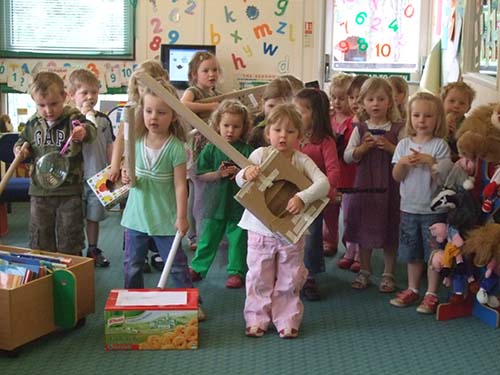 Kids of all ages (yes, even you Mom and Dad) should be exposed to lots of different kinds of music. The best and easiest way to do this is by going to the library and bringing home CDs. There are tons of great children's CDs (my favorite is Snacktime! by Barenaked Ladies) in many different styles of music. And don't shy away from encouraging your child to listen to the music that you like best. Bring home some jazz or even disco!
Another great way to encourage musical children is to get them involved in a music class. Many communities offer extra-curricular music classes for school aged kids. Here in Cedar Rapids, we have a great organization called the Eastern Iowa Arts Academy. For younger kids, many music schools and preschools offer kindermusik programs.
Finally, my favorite way to encourage your child to be musical is to play and sing with your child. Maybe you play the piano or saxophone, or maybe you're really good at banging pot lids or pounding a paint bucket with a wooden spoon. Either way, nothing gets kids more excited about music than having their parents involved. Worried about running out of ideas of songs to sing? Check out this site. It has lyrics and sound files for TONS of great kids songs (I use this website myself for my son!). Or, make up your own music. Nothing inspires creativity in your child like seeing you be creative!